

Medical injection molding is transforming – the demand for disposables, miniaturization, and EU-based manufacturing is growing, and the market has to adapt. Buyers want safer products and parts that meet strict regulatory expectations, and manufacturers are the ones who need to accommodate these requirements.
The future of medical injection molding is about combining medical-grade resin, cleanroom production, and simulation-driven design, all aiming at providing the highest-grade machinery and equipment. Operators are turning to Moldflow analysis for more data-driven molding decisions and de-risking the manufacturing process at an early stage.
What Is Medical Injection Molding?
Medical injection molding is a manufacturing process used to produce polymer parts used for healthcare products, including diagnostic machines, lab systems, clinical supplies, etc. This method uses medical-grade thermoplastics and validated molds to produce parts that remain accurate and repeatable under cleanroom or controlled-environment conditions. For such a regulated sphere, suppliers often work under an ISO 13485 quality system to maintain high product standards and traceability for materials, lots, tools, and process records.
The basic flow is similar to the traditional injection molding process. It starts with clamping, when the mold closes and is held under force. Then, during injection, molten resin is inserted into the mold cavity. After that comes cooling, when the material solidifies into the required shape, and then, during ejection, the finished part is removed.
Plastic injection molding of medical parts follows stricter standards and requires more rigid control – the parts produced this way are designed to interact with fluids, the human body, or medicinal instruments. Overly porous surfaces or micro-fractures may cause the part to behave unpredictably in a critical scenario, which is why meticulous quality control is required. Simulation-based analysis for injection mold can predict mold-fill behavior and shrinkage and help prevent production defects early in production.

Why Does the Medical Industry Use Plastic Injection Molding?
The medical device industry relies on injection molding because it supports repeatability, complex geometry, and scalable output. The method also has thorough regulatory documentation, making it easier to set up the production that complies with official requirements. In injection molding, a validated tool can produce the same part repeatedly, maintaining stable dimensions, which is important for assemblies and single-use products alike. The technique also works well for small details, thin walls, textured surfaces, and features that would be difficult to achieve with other manufacturing methods.
For engineers, predictability is another factor that matters – the method allows for reviewing the part, material, tool, and processing window before production begins. A simulation-driven front-loading design strategy helps identify every risk early in the process, when changes are cheaper. In injection molding for medical devices, this helps avoid costly last-second corrections, which often mean missed schedules and wasted materials.
In terms of business operations, scalability is another crucial factor – once a mold is qualified, the same setup can support mass production with controlled quality. This is especially relevant for suppliers focusing on disposables, diagnostic consumables, and drug delivery components, where demand can be unpredictable.
What Are the Benefits of Plastic Injection Molding Medical Devices?
The first benefit is cost efficiency and consistency – you only need to build the tool once. After that, each cycle can create repeatable molded components with very limited manual work. This allows for relatively cheap high-volume production that doesn’t compromise on quality.
The second benefit is design freedom – medical plastic injection molding can produce all kinds of parts: thin walls, snap fits, clips, micro-features, fluidic channels, etc. That is why it is used in a wide range of medical products – from labware to delivery systems.
The third benefit is material versatility – medical parts often require certain biocompatibility, chemical resistance, optical clarity, sterilization behavior, flexibility, and heat resistance. Injection molding medical plastics allows engineers to work with the specific resin that meets those requirements.
The fourth benefit is regulatory-ready production – validated settings and documented quality control measures help suppliers maintain design history files, production records, and audit expectations.
Common Medical Injection Molding Applications
Nowadays, injection molding in the medical industry is ubiquitous – it produces everything from simple disposable to complex assemblies. Below are the most common healthcare industry applications.
Implantable Devices
For implantable components, the parts need to be durable and compatible with tissue contact requirements. Injection molding allows for proper biocompatible polymer decisions, making it suitable for orthopedic, dental, joint, and surgical products.
Surgical Tools
The process is also used for surgical instruments and their parts. Injection-molded plastics are used in scalpel handles, forceps handles, clamps, retractors, positioning aids, etc. The resins used for such applications are usually chosen for strength, sterilization resistance, and biocompatibility because they must tolerate repeated cleaning and sterilization without losing structural integrity.
Consumable and Disposable Medical Products
Many single-use healthcare products are molded, including syringes, test tubes, petri dishes, drip chambers, and diagnostic consumables. For such products, PP (polypropylene) is often used because of its combination of chemical resistance and low price. Such applications also involve high-cavitation tooling and micro-molding for larger output without sacrificing dimensions stability.
Laboratory Equipment
Many lab processes, including research and testing, rely on molded containers, pipette tips, microplates, and cartridges, all of which can be produced via injection molding. The method supports clean surfaces and consistent geometry, which is crucial for repeatability across many small parts.
Medical Device Housings and Enclosures
Many diagnostics and monitoring systems need durable enclosures to protect sensitive internal electronics and maintain sterile conditions. Injection molding can be used to manufacture such housings, but it can still be sensitive to deformation, even at the manufacturing stage. Warpage and core-shift analysis for thin-wall parts can help review those risks in advance and avoid them during tooling.
Sterile Packaging Solutions
Injection molding is often used for medical-grade packaging for disposables, supplies, and equipment. Such packaging includes vials, caps, containers, blister pack elements, and protective trays. The method allows the products to be strong and sealed enough to protect the contents and keep them sterile during storage and transportation.

Designing a new medical part? Validate manufacturability and material flow before committing to tooling – request a Moldflow simulation consultation.
Key Techniques in Medical Injection Molding
Plastic injection molding of medical devices is based on several processing techniques, each focusing on a specific type of product. The most common ones include:
- Thin-wall molding: Common for lightweight housings, labware, and packaging. Useful when cycle time and cooling must be controlled.
- Gas-assisted molding: Used for manufacturing thicker sections, which helps reduce sink and overall weight.
- Insert molding: Combines plastic with metal contact, cannulas, or threaded features, often used for parts with more complex geometry.
- Overmolding & two-shot molding: Allows for adding soft-touch surfaces, seals, and grips.
- Liquid silicone molding: Uses liquid silicone rubber for flexible seals, valves, and soft-touch components.
- Micro-molding: Creates small features that rely on precise injection and tool accuracy, like catheter tips or microfluidics.
All of these manufacturing methods are used to manufacture many medical devices consistently, with reliable repeatability and quality.
Plastic Materials Used for Medical Injection Molding
Material choice affects performance, sterilization compatibility, biocompatibility, and dimensional stability. In medical device plastic injection molding, engineers normally review ISO 10993, USP Class VI requirements, contact duration, chemical exposure, and sterilization method before choosing a resin.
| Material | Typical use | Key property |
| PE, HDPE, LDPE, UHMW | Tubing, containers, wear parts, and labware | Chemical resistance, toughness, and low moisture absorption |
| PP | Syringes, caps, diagnostic consumables, and lab containers | Lightweight, cost-effective, and suitable for many disposable products |
| PC | Housings, transparent components, and connectors | Optical clarity, impact strength, and dimensional stability |
| PEEK | Selected high-performance and implant-related applications | Heat resistance, mechanical strength, and biocompatibility potential |
| PS | Petri dishes, trays, and labware | Clarity, rigidity, and low-cost processing |
| PFA, FEP | Fluid-contact parts and chemically exposed components | High chemical resistance and purity |
| TPE | Grips, seals, and flexible interfaces | Soft touch, flexibility, and bonding options |
| Silicone, LSR | Seals, valves, soft components, and wearable interfaces | Flexibility, biocompatibility potential, and sterilization resistance |
Sterilization compatibility should be checked for EtO, gamma, and autoclave exposure. A material that works well in one application may fail in another because heat, radiation, or chemicals can change color, stiffness, or dimensions.
Regulatory Compliance, Cleanroom Standards, and Quality Systems
Healthcare is the most regulated manufacturing sphere, so injection molding medical devices must meet strict requirements. The supplier has to show that the manufacturing process is controlled, documented, and repeatable, which is why medical injection molders often combine room production, validated equipment, traceable materials, and formal quality systems.
Regulatory Standards
Medical device manufacturers need to consider ISO 13485, FDA 21 CFR Part 820, EU MDR, ISO 10993, and USP Class VI, depending on the product and the target market. Another thing to consider is the device classification – while Class I products (e.g., non-sterile examination gloves) carry lower risk, Class II devices (e.g., infusion pumps) and Class III products (implantable pacemakers) require deeper documentation and validation.
Compliance always starts before production – the materials, process capability, tool validation, and inspection plans must match the intended process. Early engineering review helps detect early production issues and avoid them before the part reaches validation.
Cleanroom Manufacturing
Cleanroom manufacturing refers to controlling airborne particles and any other contamination sources, according to ISO 14644. ISO Class 7 and Class 8 environments are commonly applied for medical injection molding parts, depending on the product risk and cleanliness requirements.
To successfully classify for cleanroom molding, the environment must include clothing control, air filtration, documented cleaning, and controlled material handling. All of these help ensure the products come out consistently, and with no hazard for end-users or handlers.
Traceability, Documentation, and Process Validation
Traceability means keeping records that show which materials, machine settings, production dates, inspection results, and operators were involved in making each part. If a problem is found later, these records help identify what happened and where the issue may have started. They also help manufacturers show that the approved production process was followed correctly.
IQ, OQ, and PQ are common validation steps. IQ confirms that the equipment is installed correctly. OQ checks whether the process works across defined limits. PQ confirms that the process can produce acceptable parts repeatedly under routine conditions. Together with GMP expectations, these steps help protect patient safety and support consistent medical device manufacturing.
Advancements in Medical Injection Molding
Medical injection molding is already transforming, and the train is not likely to stop any time soon. The future of the industry is shaped by precise simulation, high-quality materials, and more connected production data. More technological machines allow for better temperature, pressure, and fill time control, meaning less shrinkage, lower cycle time, and better structural integrity.
AI-based optimization is one of the latest trends in the sphere. There are already tools that connect simulation data and measured machine data, turning it into actionable insights into workflows. One example is the AI capabilities in Autodesk Moldflow, which show how the field is moving toward connected, data-driven decision-making.
Many injection molding medical projects also rely on 3D printed prototyping now. Engineering teams can receive the first test parts much faster and perform short validation runs to check geometry early on. This kind of rapid prototyping helps save resources on the initial testing and dedicates them to the actual production.
New biocompatible polymers are another thing to consider. They expand the design and options and give the engineers materials with better sterilization resistance, transparency, chemical compatibility, and flexibility. These materials can be used all across the industry – from small medical components and wearable products to drug-delivery systems and diagnostics machines.
Suppliers are also increasingly turning to sustainability in the form of using recycled or bio-based resins where regulations and device risk allow them. Others focus on eco-friendly medical molding by employing energy-efficient presses, optimized cooling, and simulation work that reduces material waste.
Training turns simple injection-molding medical teams into qualified, efficient decision-makers during early design and tooling review. Moldflow training and certification help engineers build in-house expertise and optimize their medical injection molding processes.
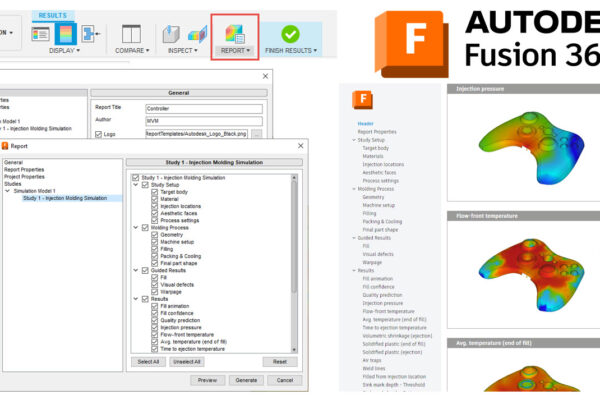
Integrated CAD and CAE workflows also support faster development. When the simulation is closer to the CAD model, teams can test design changes earlier and reduce handover delays. Simulation extensions in Autodesk Fusion are one example of how design and analysis workflows can become more connected during medical device manufacturing.
Ready to bring simulation-driven design into your medical device development process? Get in touch with our team – we’ll help you find the right fit, whether that’s software, training, or an engineering simulation service.
FAQ
How is medical injection molding different from standard industrial injection molding?
Medical injection molding relies on stricter material control and requires more meticulous documentation, traceability, quality systems, and process validation. Most projects also require cleanroom production.
Which materials are considered biocompatible for medical devices (ISO 10993, USP Class VI)?
Common options include selected grades of PP, PE, PC, PEEK, silicone, TPE, and fluoropolymers.
How long does it take to build a mold for a medical component?
The timeline depends on the complexity of the tool and the validation needs. A simple mold may take up to several weeks, while a complex validated tool will likely take several months.
Can implantable devices be manufactured by injection molding?
Yes, you can injection mold implantable components and entire implants, like joints or dentals, can be injection molded. Such parts must meet strict biocompatibility and regulatory requirements.
How many sterilization cycles (autoclave, EtO, gamma) can a medical-grade plastic part withstand?
It depends on the material, its geometry, and the method of sterilization. Most common materials and how many cycles they can withstand:
- polypropylene – 10
- polycarbonate – 50-100
- PEEK – 1,000+
In terms of sterilization method, EtO typically has minimal impact even over dozens of cycles, while gamma sterilization of 25-50 kGy tends to tear down plastics faster.
What is IQ/OQ/PQ, and why does it matter for medical device manufacturing?
IQ is installation qualification, OQ is operational qualification, and PQ is performance qualification. Together, they show that equipment and processes can consistently produce acceptable parts.
What questions should you ask a potential injection molding partner for medical devices?
Clarify their ISO 13485 certification, cleanroom capability, traceability systems, validation process, DFM process, materials handling, inspection methods, and simulation capability.
Can mold tooling costs be reduced without sacrificing part quality?
Yes, especially through early DFM review, simulation, and sensible tolerance choices.